Accessing AI Value Today
Missed Opportunities and the HR Failure
AI narratives currently oscillate between spectacle, hype, anxiety and a sense of emerging disappointment. Investors are deploying extraordinary sums in pursuit of as-yet-speculative agentic systems and monetisation. Ordinary users have embraced the simple ability to ask and receive answers without the usual digital friction. Many businesses remain unsure how to start, while employees feel the tension of potential displacement. A faint sense of fatigue is already visible, and some observers are beginning to anticipate an AI downturn.
AI is real, and it is commercially meaningful, but only if organisations choose to direct it towards concrete, immediate problems. Hesitation or a fixation on speculative transformation produces paralysis and waste. There are accessible gains in unglamorous operational domains. Human Resources is the clearest example. It remains one of the least effective corporate functions despite direct access to tools that could improve accuracy (screening), fairness (evaluation) and communication (candidate engagement) with minimal effort.
Faking It Is Not A Strategy
Many organisations, uncertain about how to engage with AI, have resorted to rebranding long-standing tools as if they were new. Chatbots predate the current wave of language models by years. Data analysis and statistical modelling have always driven financial planning and forecasting. Industrial robotics has been automating tasks for decades. Presenting these legacy systems as AI is a temporary response to pressure rather than a substantive shift. Combining advanced technology with outdated practice is not adoption; it is a holding pattern that reveals a lack of managerial direction.
Using AI to Make HR Better Immediately
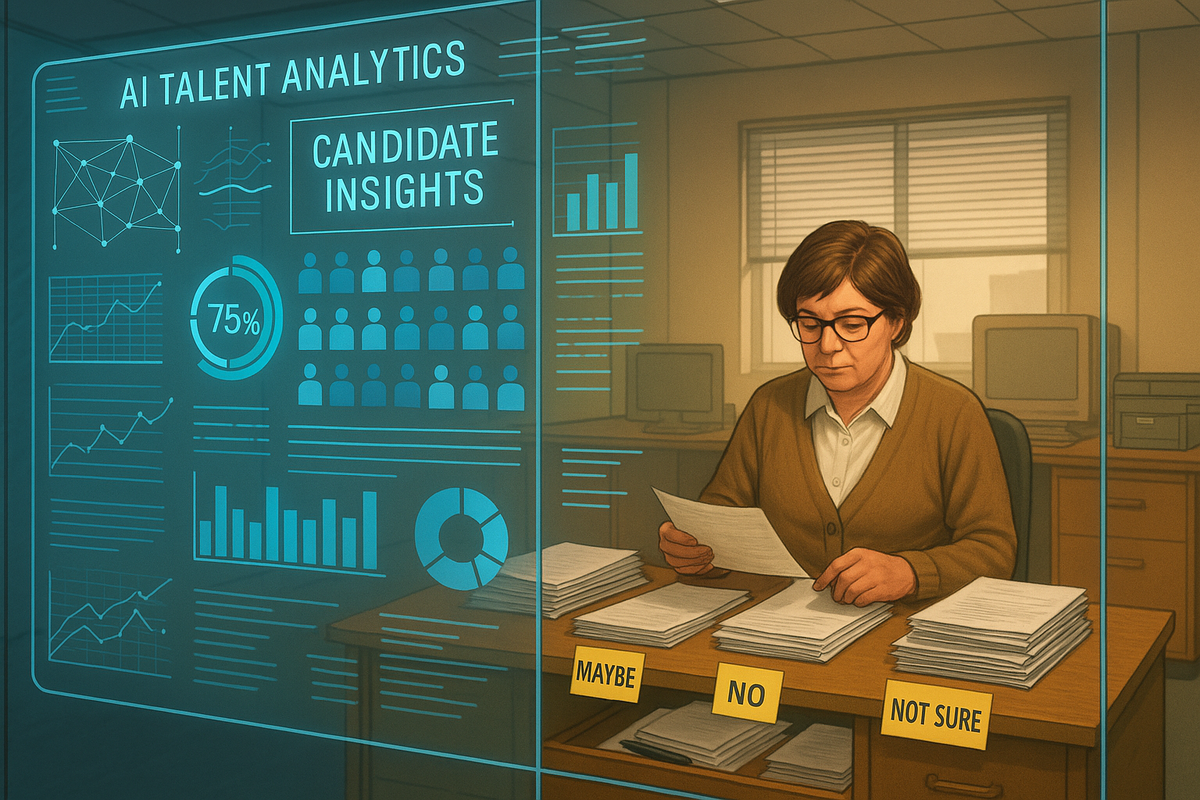
HR illustrates the problem clearly. The early stages of hiring are heavily automated, but the tools belong to an earlier technological era. Departments that speak confidently about digital transformation still depend on keyword filters from the early 2000s, generic rejection templates, rigid screening systems that misread experience and interview frameworks that prioritise “fit” over capability. These systems were designed to reduce workload, not to identify talent. Modern AI can close that gap by bringing context, accuracy and structured judgement to the process, yet HR practice remains unchanged. The technology has advanced; the function has not.
AI can already make HR better—right now—without any hype. At the level of accuracy and fairness, AI can:
• analyse actual work outputs rather than CV formatting
• match real skills to real job requirements
• write personalised and respectful communications at scale
• summarise interview notes and compare them against explicit criteria
• generate realistic work tests based on the organisation’s actual tasks
None of this is theory. It is available and cheap. All HR departments could have done this already. As a pilot, the outputs would be measurable and impactful. Hiring the right people improves business.
Business Functions Are Falling Short
Why are functions failing to start with accessible, cheap, effective AI? The challenge is cultural. Moving from the strategic to the tactical surrenders potential gains if technology is used more to reduce human accountability rather than to enhance judgement. The significance of AI is in its ability to enhance and speed up human judgement. It is more of a partner than a tool. Current HR systems filter out complexity, nuance and unconventional candidates. They preserve managerial convenience at the cost of organisational competence. This function, and others, need to raise their ambition to understand what AI can do immediately and over time. There is diminishing justification for holding to outdated deployments of old technology.
Start Already
HR exposes the broader pattern. Organisations at the functional level are holding off on achievable transformative outcomes while relabelling existing practices and avoiding substantive change. The result is that AI in many businesses is at worst a meaningless label, at best underused. The AI narrative veers towards complaint, and inaction becomes justified.
Stop preparing. Stop procrastinating. Early, practical AI success will come from unglamorous domains: hiring, compliance, operations. These functions do not need a breakthrough. They need intent and discipline. They need the first steps. HR is proof that the gap is behavioural, not technological.