AI and the Meaning of Shared Intelligence
From Craftsmanship to Industrial Scale
Before the Industrial Revolution, technical expertise existed mainly in individuals. Building something large or complex required many relatively well-paid craftsmen, each skilled in slightly different ways. Industrialisation changed the world not simply because it made production cheaper, but because it made production at scale possible with far greater consistency of quality.
AI will do the same for intellectual expertise and specialised memory. Today’s great professionals are highly valued because of their knowledge and experience, which from an AI perspective can be understood as accumulated pattern exposure combined with recall under pressure. They synthesise information from diverse sources, recognise patterns across projects and over time, and summarise and draft effectively. These are precisely the functions that algorithms now perform rapidly, drawing on vast datasets in real time. In the non-AI world, expert output varies significantly. Quality depends on attention, experience, and stamina, and, as with craftsmen before industrialisation, output scales only by adding more experts.
The big change with AI is that, by encoding patterns of reasoning, language use, and problem decomposition into systems that are repeatable, cheap, and fast, intelligence no longer sits primarily in the individual. It shifts from a person’s ability to synthesise and recall into process, architecture, and workflow. Intelligence can now be embedded directly in the business model or operating process. As with industrial machines, this increases capacity, reproducibility, and in many cases consistency of quality.
From Knowledge Work to Cognitive Scale
To understand what this means beyond the obvious, consider the precision screw. Without mass production screws were known, but not easily made. As a result mechanical construction relied on wedges, joints, bespoke parts and ingenuity. Assembly required craft. Parts could not be replaced without reworking. All this imposed hard limits on scale and reliability. One could build complex machines, but only slowly, expensively, and with high dependence on individual artisans.
Once industrialisation enabled the mass production of precision screws, a cascade of second-order effects was released. Screws became affordable in quantity and reliably interchangeable, which reduced assembly risk. Maintenance replaced continual refitting. Increased precision fed back into machine tools themselves, allowing more accurate equipment to be built using the machines already operating, which made larger and more complex assemblies feasible and scaling less fragile. The nature of work shifted accordingly: fewer outcomes depended on individual craft judgement, and more depended on adherence to defined processes and standards. Less-skilled craftsmen became operators while more skilled and differently skilled craftspeople became designers, managers, process managers.
With AI, we can expect a similar shift. Certain cognitive tasks such as drafting, summarisation, and routine analysis will become standardised and widely accessible. The primary value in knowledge work will move away from execution toward design, oversight, and validation. Beyond these new feedback loops will emerge as AI reshapes how problems are framed, and iterated. Capacity increases, iteration costs fall, and forms of creativity that depend on rapid exploration rather than individual virtuosity become easier, pulling in more people to drive progress forward. As with industrial machinery, scaling intelligence in this way also increases the consequences of error, since failures propagate across systems rather than remaining local.
Judgment in the Age of Shared Intelligence
While industrial and intellectual automation share effects such as skills being externalised, consistency improving, individual discretion reducing, and mistakes becoming more consequential, there will be important differences in the impact of AI.
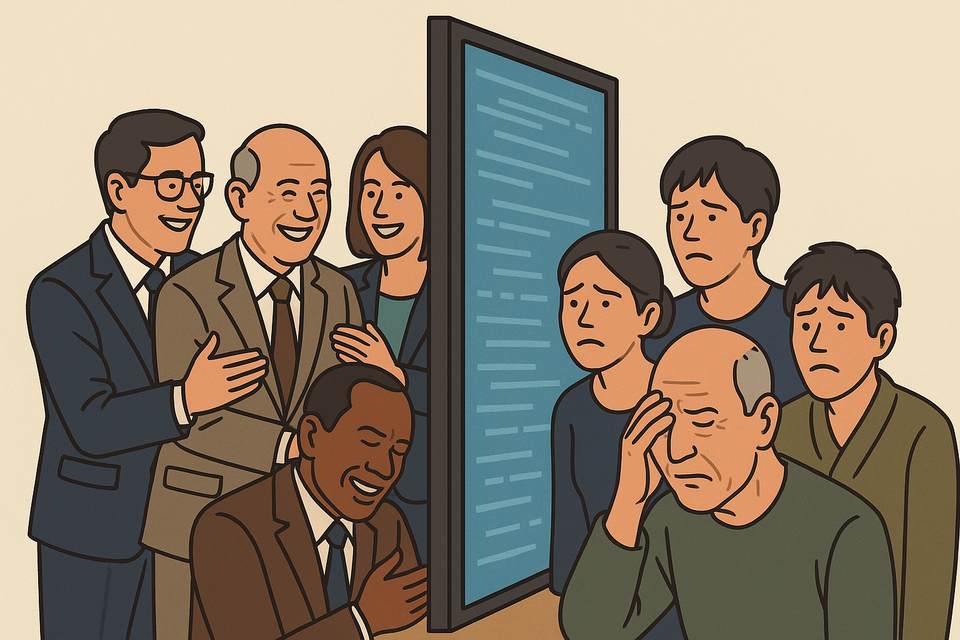
A machine enforces consistency in the physical domain. AI delivers statistically optimised outputs. Therefore the need for judgement increases.. Instead of performing the intellectual task, humans must decide whether the AI outputs should be trusted in a particular context, with particular consequences. This role is more akin to inspectors, engineers, and regulators than to craftsmen.
At the individual level, AI will make some work feel less valuable and other work more consequential, depending on where judgement, responsibility, and risk now sit. At the system level, the shift is more fundamental: value moves away from performing knowledge tasks toward defining models, incentives, constraints, and failure modes. This is where power and accountability concentrate. As the industrial revolution made mass production possible, with all its intended and unintended consequences, AI makes mass cognition possible. What follows will not be determined by the technology alone, but by how this newly shared intelligence is governed, and by which individuals and institutions learn to use it to act in ways that are not yet visible from the present. The challenge is no longer how to build intelligent systems, but how to govern intelligence that now resides beyond the individual