HR’s Brave New World of AI – Desperately Seeking a Reboot.
Past Performance May Not Be The Best Guide to the Future
HR has been one of AI’s earliest adopters — and one of its biggest disappointments. Far from revolutionizing hiring, ‘classic AI’ has trapped candidates, frustrated CEOs, and delivered little more than keyword lotteries.
A feature of AIs ever growing prominince is companies and sectors claiming that they are already deploying it. This reassures shareholders, but doesn't stand up to much scutiny. The sleoight of hand is achieved by labelling everything that happened before ChatGPT etc as "Classic AI", which then allows everything from sales statistics, keyword filters, rule-based screeners, and clunky chatbots to count.
Understandable as a short term confidence booster, but it risks complacency. What has been hapened up to now is not a good guide to what is possible, and if a sector or function measures itself against the past, it risks missing out on the true impact of whats coming. Human Resources is a good example of this.
How HR Makes AI Look Bad
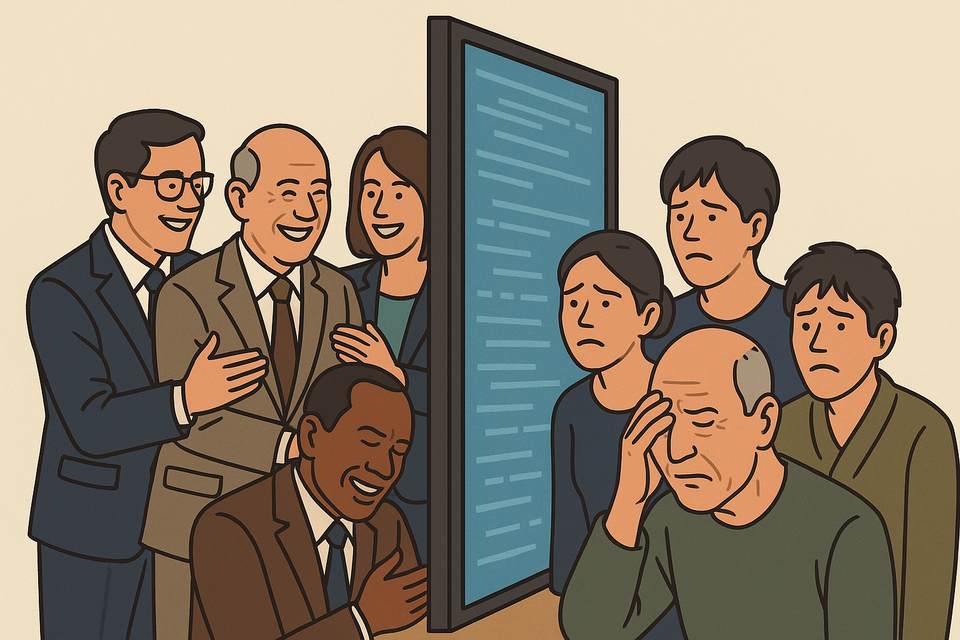
HR was one of the earliest adopters of “classic AI.” Many job seekers, CEOs of mid-sized companies, and even HR professionals themselves are uneasy with what that adoption has produced. What once held promise has delivered little more than automated rejections, thinner insight, and weak management of the talent pool.
CEOs (especially SMEs) still waiting for value
- Pay for inefficiency as strong candidates are still screened out.
- Suffer brand damage when frustrated applicants spread the word.
- Receive filtered CV piles and imperfect shortlists instead of judgement.
- Never see the strategic value of an actively managed talent pool.
Candidates trapped in a false exchange
- Gaming the system is now routine: both sides reduced to keywords and stock phrases.
- Automated screening fails the capable but rewards the self-promoter.
- CV databases go stale, useless when the next hire is needed.
- Stock rejections destroy goodwill instead of providing clarity.
HR diminished, not enhanced
- Automated filtering and rejection replaced active search and engagement.
- Soft skills are applied too late, to a smaller and flawed shortlist.
- More complex uses of AI are avoided under cover of legal and bureaucratic excuses.
Inward Looking AI Is Not Enough
A feature of “classic AI” was that it seemed to benefit the companies deploying it more than their clients. Call handling, scripted chatbots, and targeted marketing sat well with operations and finance directors, but less so with users. Processes were quicker, costs were lower — what’s not to like?
The problem is that no business succeeds on cost or efficiency alone. The strength of a well-run company lies in the balance of priorities across functions, anchored by the requirement to meet customer needs. Tilt too far inwards and you may save money while destroying value.
Applied to HR, the same logic holds. The purpose of hiring is to find the best candidate, not simply the best job hunter. Classic AI delivered more efficient processes and lower costs per hire, but not necessarily better outcomes. It stayed passive and formulaic, filtering and rejecting but not enabling active, interactive, and personal hiring.
AI 2.0 More Ambitious, More Successful
For AI 2.0 to deliver, HR needs to stop postponing judgement until the last possible moment. It needs to return to managing job seekers in an interactive, mutually useful way. Natural-language interaction combined with integration into company systems can do this in several ways.
The weakest part of the process has always been filtering before any human with soft skills is involved. Context and inference — not keywords — should drive hiring. The keyword approach has two fatal weaknesses. First, it is irretrievably gamed by a subset of candidates fluent in jargon and self-marketing, leaving better-suited people in the auto-rejection heap. Second, it is the wrong place to start. Hiring is an inverted champagne glass: masses of mixed-quality CVs at the base, narrowing to a few interviews. Yet it is only in interviews that meaningful information about the person emerges. AI can now front-load that kind of interaction, producing stronger shortlists more quickly.
An Interactive Portal
Natural language turns interaction from a keyword lottery into a real-time exchange, where AI can interpret, coach, and draw out skills and personality traits relevant to the role. This makes shortlisting more humane and more accurate — and it can be “always on.”
Instead of submitting a CV to a single vacancy, candidates could enter a live pool where they explore roles, understand career paths, and reveal skills and concerns through the questions they ask.
The cultural shift required is towards exchange, not one-way traffic. A modern HR portal must work both ways: candidates ask questions, companies provide structured AI-mediated answers. Every exchange enriches the assessment. Legal and confidentiality concerns can be managed — not by refusing to say anything meaningful. There is a risk–reward dynamic: invest more in potential candidates and get better hires.
Fluent AI can also repair other long-standing weaknesses. Communication with unsuccessful candidates has long been late, bland, and information-free. Fear of ongoing dialogue with disappointed applicants has justified bureaucratic silence. Yet AI can provide context-rich responses that leave candidates better informed and more willing to stay engaged for a future, more suitable role.
Bias is another weakness. The complexity of AI has exposed the bias embedded in historical datasets. Instead of hard-coding those distortions through keyword filters, AI can embed bias checks from the start and use interactive exchanges to minimise — ideally eliminate — bias. AI can break bias, not entrench it.
AI is Transformational, Not Incremental
Hiring is only one part of HR, but it is the most visible. Talent identification is essential for successful businesses, and in the unforgiving world of accelerating AI capabilities, HR must step up.
Technology should empower people — candidates and HR professionals alike — not merely automate rejection and communication failures, and then start over for each new hire. The winners in HR won’t be those who automate rejection. They’ll be the companies that reinvent hiring as a dialogue — where AI doesn’t replace human judgment, but amplifies it. Anything less is yesterday’s AI dressed up as tomorrow’s innovation
As AI accelerates, the message is clear: this is not about automation, it is about redesign. Not about less human, more machine — but about machine and human combining interactively to raise both productivity and quality.