Restoring Consumer Power in the Digital Economy
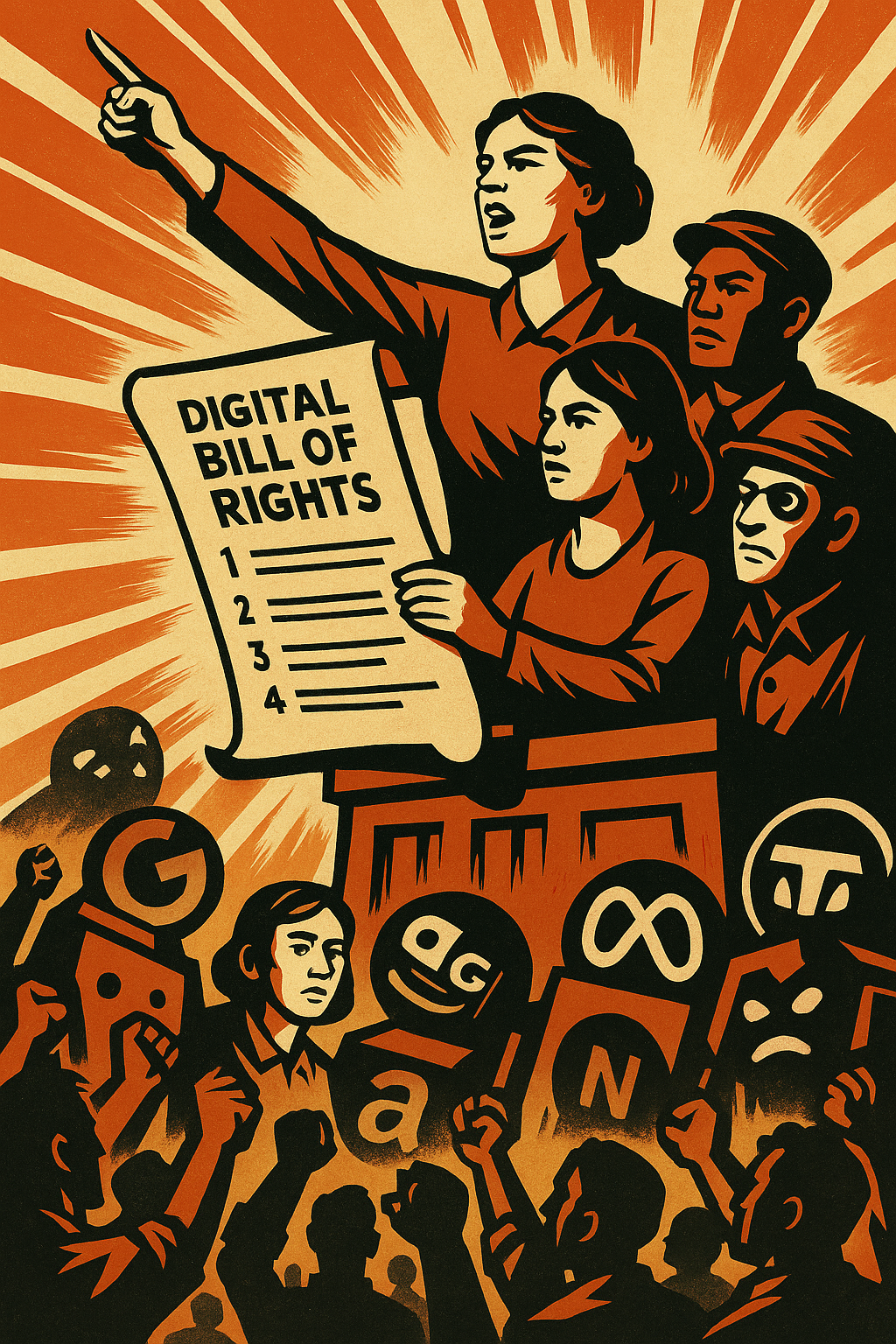
Summary: The digital economy has delivered global connectivity and immense value, but its scale now conceals a re-emergence of damaging practices: ownership diluted by endless subscriptions, consumers denied the right to hold steady on functional products, and personal data harvested without price or compensation. Governments are too slow to counterbalance, as fines arrive years late and are absorbed as routine costs. The remedy is a Digital Bill of Rights that restores parity by pricing data fairly, protecting ownership, guaranteeing a right to hold steady, and exposing manipulation in real time through public compliance. Enforcement must work in the now, with compliance tied directly to brand reputation. The aim is simple: the digital marketplace must serve people, not just shareholders and suppliers.
A System Out of Balance
The digital economy has created the most valuable companies in history — firms that delivered AI, mobile connectivity, and radically new business models. While delivering clear benefits this concentration of power has also resulted in unprecedented scale and influence for the market leaders. At the same time, a profound imbalance is visible: consumers are disempowered, governments outpaced, and corporate incentives reward extraction over service.
What follows is not an attack on the tech sector's creativity and commercial intent. It is instead a critique of “innovation hype,” where the umbrella of everything digital conceals the reemergence of old monopolistic practices in new forms. It examines how new exploitations like unpriced data and ownership transfer have taken hold, and why existing regulation is inadequate. More importantly, it proposes a solution: a Digital Bill of Rights that restores balance by pairing legal enforceability with brand accountability in the court of public opinion.
Great Power … and Great Responsibilities
Google, Meta, Amazon, Apple, Microsoft, Tencent, Alibaba, and Nvidia are the commercial champions of the digital economy. Together they have created a new narrative of business success and impact
- Productivity & scale: Digitalisation has been one of the largest drivers of global productivity since the industrial revolution — reshaping trade, finance, communication, and daily life.
- Market value: The five largest tech companies now exceed the combined market capitalisation of many G20 economies.
- Reach & adoption: More than 5 billion people use digital platforms daily; no prior technology spread globally this fast.
- Consumer benefit: Costs of communication and access to information have fallen to near zero in many domains — a profound shift in human connectivity.
- Systemic role: Digital infrastructure underpins everything from payments to healthcare, logistics, and energy grids — as foundational as electricity
Yet the very scale of these gains has also concealed a re-emergence of damaging business practices, amplified by new forms of exploitation: unpriced data, creeping ownership theft, and the systematic disempowerment of consumers. To see how we reached this point, we begin with an examination of the shields companies use to disguise exploitation:
- Innovation brings monopoly and lock-in
- Choice becomes manipulation and channeling
- Freedom means monetising human frailty without accountability
What’s New is Also Old … Relabelled and Amplified
The Digital Sector’s Problem with Competition
Monopoly, lock-in, and customer disempowerment are elements of the new digital economy, protected by strategic lawbreaking. None of these, nor the tactic of “delay, dispute, and pay the fine,” are new — they are simply reappearing in digital form with new names.
There is a tension between success and competition. Innovators want to reap the reward of their creativity and hard work. The economy, however, needs the constant creative tension of competition to promote further innovation and avoid the abuses of price gouging, loss of choice, and decline in standards.
Repetition and good PR dull the impact of today’s reality. Google and Apple fight to maintain their lock on their markets, contesting cases for years in court and paying huge fines. Google narrowly escaped break-up, on the dubious grounds that market conditions were changing too quickly for courts to rule effectively. Nvidia has become such a strategic and dominant supplier of advanced chips that it is now part of geopolitical manoeuvring.
Self-interest, vast resources, and the best lawyers cannot be allowed to erase decades of work to protect society’s interests in innovation and fairness. "Litigate and pay the fine” is a corporate strategy misaligned with society’s drive to improve outcomes for all.
Ownership and the Subscription Trap
Ownership is fundamental: you pay, you own, you enjoy. Today, that principle is under assault. Big Tech has normalised endless subscriptions and complex terms that dilute ownership without consent.
Software updates once meant stability and security; now they are used to corral consumers into perpetual payments, disable older devices, or reconfigure products after purchase. A laptop or phone that could last a decade is treated as disposable. Even cars can lose features remotely: Tesla has disabled functions post-sale, while BMW has tested subscriptions for heated seats.
The tactic is always the same. What begins as convenience — updates, bundled services, subscription access — becomes dependency. Ownership is hollowed out, replaced by inertia and manipulation. The healthy requirement that companies persuade consumers with value has been replaced by the power to enforce terms after purchase. Servitude has replaced service.
The Right to Hold Steady
Consumers also need the right to say “enough.” Software must be updated to correct errors and maintain security. But these essential functions have become a cover for adding new features, demanding more power, and forcing unnecessary upgrades. Together, these practices force consumers into constant hardware purchases, even when current performance is sufficient.
A ten-year-old phone or laptop that still performs basic tasks is treated as obsolete. Apple was fined in France for throttling older iPhones — a clear case of planned obsolescence. Cars too can be stripped of functions already paid for. The EU’s “right-to-repair” legislation is a step forward but remains partial, contested, and weak.
Digital services must recognise a consumer’s right to hold steady at a functional baseline. If someone chooses to freeze their product at a working level, they should be able to do so without losing core functionality. Products must be supported as sold — just as a car can serve for decades with proper care.
Data Has Value — So Put a Price on It
Personal and public data has immense value — and entire business models now depend on capturing it. What began as a fair exchange of entertainment for information has flipped into outright extraction. Data is no longer used to widen choice but to drive manipulative feeds and monetise attention at all costs, amplifying both the best and the worst of human behaviour.
This is not about freedom of expression. It is about fair exchange. Services should deliver value without harm, and consumers should know the price of what they are surrendering. Today, that price is hidden — even as data drives extraordinary profits. Without visibility, consumers cannot judge whether the trade is fair, or choose to be compensated instead.
Civil Penalties Are an Inconvenience to Trillion-Dollar Companies
Governments try to respond but are tactically outpaced: due process is slow and resource-intensive, so fines that arrive years later are treated as routine costs. Market leaders entrench themselves across hardware and daily life and deploy political influence to preserve their position.
The United States remains commercially passive, protecting national champions. China strengthens state-linked platforms. The European Union, though the most active (GDPR, DMA, DSA, Data Act, eIDAS), enforces slowly and unevenly — leaving users with rights on paper but little leverage in practice.
From Diagnosis to Remedy
Without decisive action, delays continue to favour companies: data stays unpriced and ownership is diluted by creeping software control. The remedy is a Digital Bill of Rights that restores parity now—protecting ownership, pricing data fairly, and guaranteeing a right to hold steady—enforced through public, standardised compliance statements (brand accountability) and immediate financial penalties where rules are breached.
A Digital Bill of Rights
Digital markets move faster than existing consumer protections. For the first time in history personal data has measurable value, yet that value is hidden and exploited. Ownership, long a cornerstone of economic systems, is being diluted through software control. Consumers can no longer buy and enjoy at a pace they choose; instead they are coralled onto a cost-intensive upgrade path where “good enough” is no longer allowed.
Levelling the Digital Playing Field
Technology’s speed and creativity are rightly celebrated. The lone entrepreneur with a breakthrough idea remains a powerful story — and innovation by small firms should be supported. In today’s market, dominant platforms are not small — they need oversight, not indulgence. Alphabet, Meta, Amazon, and the new wave of AI giants deploy vast teams and budgets, prioritising speed to market. Innovation itself is not the problem. The problem comes when speed is used as a cover for business model changes that reduce choice and weaken consumer rights.
The answer is accountability in the now. Consumers need a way to hold companies to their responsibilities without fighting an unwinnable battle of resources. Protection must be simple and immediate — as accessible and powerful as casting a vote.
A Digital Bill of Rights provides this framework. The skeleton is clear: data must be priced transparently; ownership cannot be diluted by stealth; forced upgrades must be eliminated. To give these principles teeth, companies should be required to issue an annual, standardised compliance statement. Published in plain language and shared through public channels, these statements would bind consumer rights directly to brand reputation through the feedback loop of public attention.
Public activism has already shown its force. Apple reversed course after the iPhone throttling scandal; WhatsApp delayed its privacy policy update after mass defections to rivals; Netflix softened its password-sharing crackdown after cancellations. Brand pressure worked in each case — quickly, and without waiting for regulators.
This is how consumer power can be restored.
Final Thoughts
Innovation, choice, and freedom remain valuable — but only when stripped of distortion and manipulation. A Digital Bill of Rights restores balance by:
- Pricing data fairly.
- Protecting ownership from creeping control.
- Guaranteeing the right to hold steady at a functional baseline.
- Exposing manipulation in real time through public compliance.
Enforcement must be immediate. Consumers regain power through brand impact in the court of public opinion, while companies face penalties that bite now — not years later.
There are wider benefits too. The treadmill of “bigger, better, faster” as the imposed default is unsustainable. Embedding the right to hold steady is not just about fairness — it is about conserving resources, reducing waste, and allowing technology to serve society instead of forcing endless consumption.
The digital marketplace must serve people, not just suppliers and shareholders. A Digital Bill of Rights is where we draw the line.