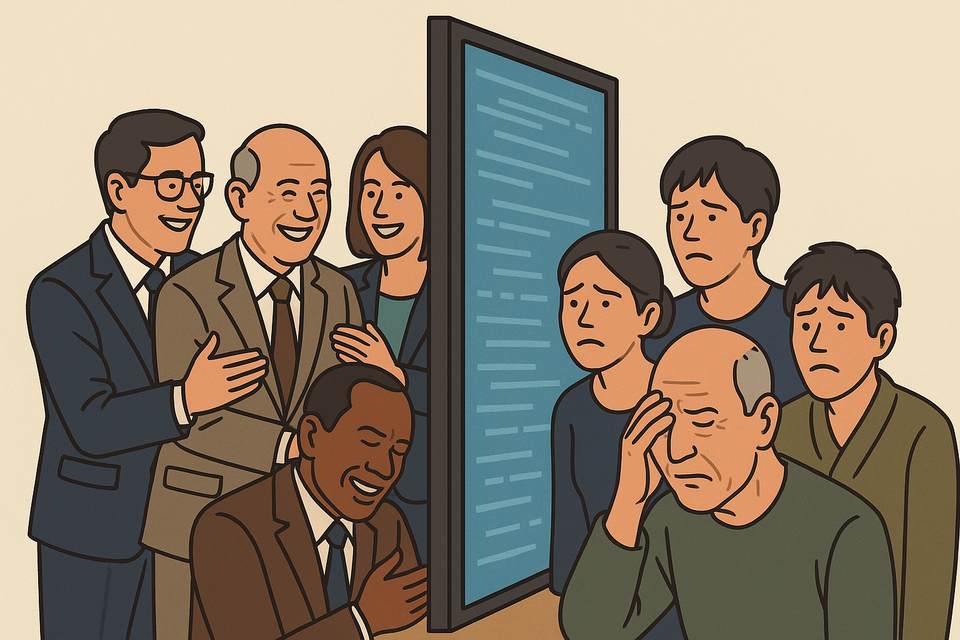
Retiring Productivity .... Why?

Advanced economies express persistent concern about weak productivity growth, labour shortages, fiscal pressure from ageing populations and widening skills gaps. At the same time, institutional norms still encourage capable, productive workers to withdraw from roles in their 60s, at a stage when many remain highly effective, motivated and still building financial resilience for future health, security and leisure.
This tension receives relatively little sustained attention, overshadowed by the familiar focus on pension costs and perceived entitlement. Yet the routine loss of productive workers at this stage of life reflects a structural misalignment between modern longevity, knowledge-based economies and inherited labour market design. The question is not whether retirement is an essential and valued social benefit, but whether a more flexible understanding of it could allow societies to retain productive capacity while preserving individual choice.
Why We Retire the Way We Do?
The post-war retirement settlement was rational in its time. Shorter healthy life expectancy, physically demanding work and the need for labour market stability made a defined end to working life both socially valuable and economically workable. Conditions have changed. Work is increasingly desk-based rather than physical, and careers extend over longer horizons.
Experience has become a central economic asset, one that accumulates. Yet while still near its productive peak, it often ends abruptly at retirement. That downshift represents a loss for employers, employees and the wider economy, and it is increasingly out of step with both individual needs and economic reality.
This is not simply a pension funding issue. It is a productivity issue. Societies invest heavily in education, professional development and accumulated expertise, yet frequently structure incentives in ways that sideline that capacity while it remains active and useful. Viewing retirement as a spectrum of participation rather than a single event opens the possibility of preserving choice while aligning institutions more closely with economic reality and human wellbeing.
The Quiet Cost of Lost Experience
Retirement debates typically centre on fiscal sustainability or entitlement. Much less attention is paid to the productivity cost of sidelining capable workers while they remain effective. The transition is often abrupt: accumulated knowledge, mentoring capacity, institutional continuity and tax contributions are replaced by training costs, replacement friction and, in many cases, net fiscal outflows.
Why Retirement Became Binary
The abrupt shift from specialised organisational productivity to generalised non-participation is what jars. Retirement has evolved into an institutional expectation shaped by pension eligibility rules, tax thresholds, benefit design, employer HR practices and cultural assumptions about “making way”. It functions as much as an identity marker as an economic transition.
Yet retirement need not be structured this way. As a fixed event, it is largely institutional design rather than economic necessity.
Purpose After Work
Some retirees thrive. Others experience loss of structure, purpose or social connection. Sudden transitions tend to amplify disruption, while gradual adjustment often produces smoother outcomes for both individuals and organisations.
Retirement could focus more on modulating contribution and less on ending demanding work outright, particularly where such work remains valued. Models already exist across a continuum: continued full engagement, reduced hours, advisory roles, selective participation and eventual withdrawal.
Greater optionality can support dignity of choice while preserving valuable productive capacity.
Evolving the Culture of Retirement
Shifting how productivity intersects with retirement is challenging but not unprecedented. Retirement framed as reward has proved resistant to change. Yet norms often shift when defaults evolve rather than when freedoms disappear.
The freedom to retire should remain intact. As health, longevity and expectations change, retirement can coexist with a culture in which continued contribution is normal and institutional pressure against working longer diminishes.
A modernised approach might include:
- phased retirement pathways
- tax neutrality for continued work
- pension flexibility
- employer incentives for retention
- visible early adopters
This is evolution rather than disruption, though the cumulative impact could be substantial.
The Intergenerational Dimension: Older vs, Younger
Encouraging longer productive participation has intergenerational implications. Retirement has often been framed as making space for younger workers. In knowledge-based economies, experience more often complements rather than displaces younger talent. Mentoring and layered expertise tend to raise overall productivity.
Demographic trends reinforce this logic. Fewer younger workers and longer lives mean productive participation later in life is increasingly economically relevant. However framed politically, rising fiscal needs are unlikely to disappear. Abruptly moving productive workers from contributors to net recipients is a blunt response to a complex demographic reality.
Adding Choice to Institutions and Working Practices
Preserving later-life productivity operates at three levels.
- Institutional: employment policy, tax design and pension frameworks.
- Organisational: job design, retention strategies and productivity management.
- Individual: stigma-free choice over how long and how intensively to remain engaged.
All are feasible, though none are simple. The incentive extends beyond productivity to a more balanced work-life trajectory that is better funded for both individuals and institutions. Flexibility enhances not only productivity but also social trust and fiscal resilience
Productivity for the Long Term
The post-war retirement settlement delivered dignity and security after a lifetime of work. That achievement remains significant. It reflected the economic realities of its era. Those realities have evolved, and institutional design must evolve with them.
Growth and productivity underpin healthy societies. A more flexible approach to later-life work can enhance both while supporting wellbeing and financial resilience for those who choose to continue contributing.
Retirement need not be a single event. Seen instead as a spectrum, it offers a way to align human wellbeing with economic sustainability, redesigning work and pension systems to be more flexible, more productive and better suited to longer lives.