Talent Trumps Bloodlines: A Diamond Geezer’s Proof
From Royalty to the East End
If you get a chance, watch the edition of Who Do You Think You Are on the BBC where Danny Dyer discovers he is a direct descendant of Edward III.
Danny Dyer (1977 – ) is a London-born actor and the go-to choice for authenticity in working-class roles. He is a self-made figure with working-class roots, and charisma. As he has expanded his range, he has remained both bluntly streetwise and unexpectedly reflective. He is well on the way to being a UK “national treasure” — a “diamond geezer” whose success owes nothing to privilege and everything to talent.
His 22× great-grandfather, Edward III (1312 – 1377), was placed on the throne aged 14 by his mother and her lover, who he promptly executed. He went on to launch the Hundred Years’ War attempting to add the French crown to his English one. Over 50 years of his reign he constantly pursued wealth and power through conquest. His break came by blood, but his own undoubted talent for war and politics made him one of the more impactful and memorable English kings. His line, the Plantagenets, lost the crown to the Tudors at Bosworth in 1485.
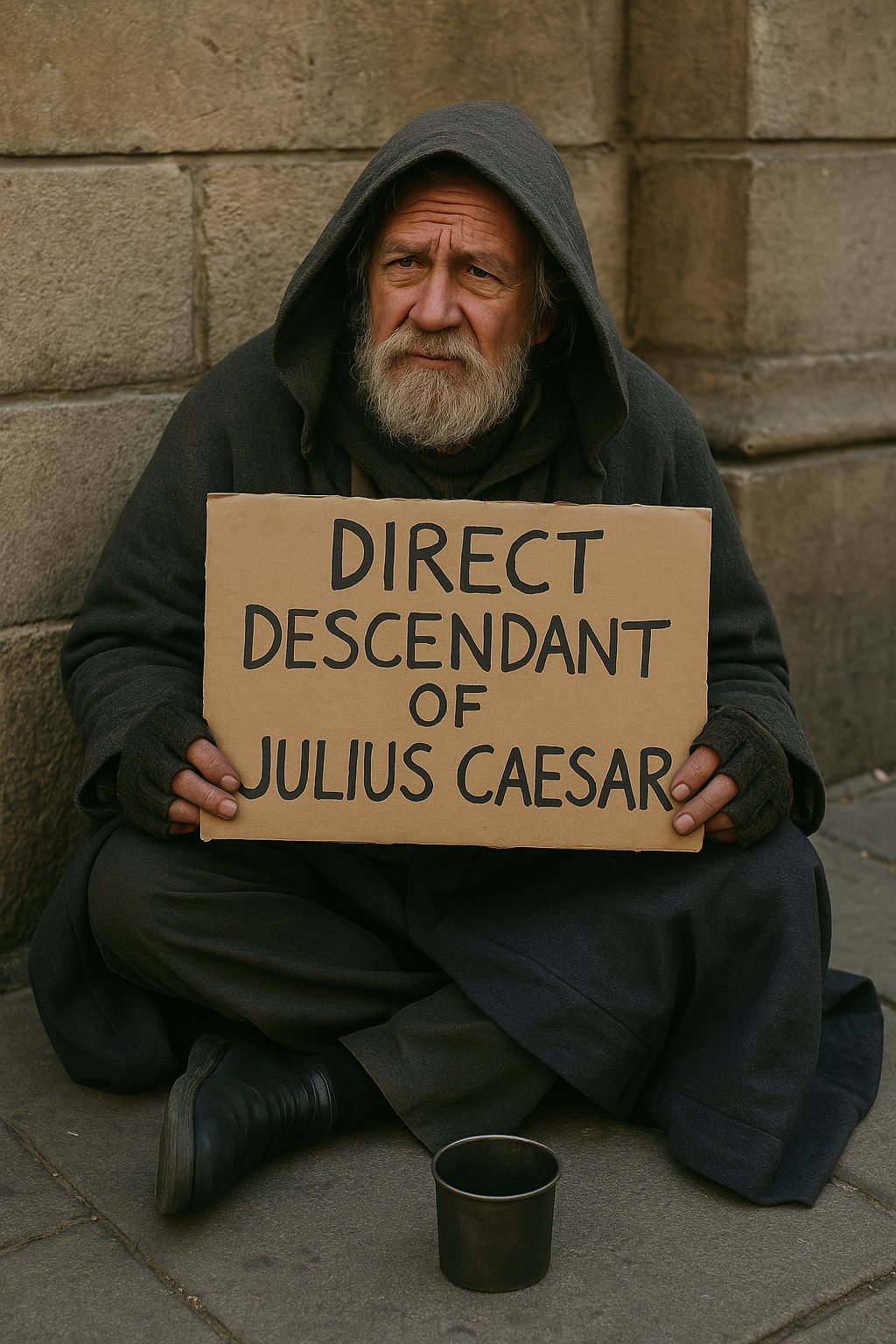
So one can only imagine what Danny expected to find in his ancestors, but his reaction to the revelation is priceless — disbelief, humour, and, endearingly, honest laughter. The arc over six centuries from one talented man to another is extraordinary, dipping into complete obscurity for most of it. Edward was the most powerful figure in Britain, with immense inherited wealth enhanced by killing and conquest. Danny is powerful in a new way — a very successful, self-made actor and media personality, less wealthy and, I’ll go out on a limb here, not a murderer. The arc is also absurd, even comic, when you consider how in 23 generations all was forgotten, all the wealth lost, until it resurfaces, improbably, in an East End boy starting over.
My pleasure at seeing Danny’s authentic amazement draws me to reflect on how privilege — and the temporary legitimacy of bloodlines and stolen wealth — still shapes our world, even though this perfect example shows it has no real substance.
Aristocracy is money laundering for genes.
The first title can come from acts of awful immediate and historic consequence: Columbus and his descendants rewarded with a dukedom, or the conquistadors granted marquisates for massacres, enslavement, and looting. The British did the same, rewarding Arthur Wellesley with a dukedom after Waterloo and General Horatio Kitchener with an earldom after Omdurman — though Kitchener’s line ended, the prestige of the title lingers.
The crowns of Spain and Britain understood the same logic: turn blood into respectability, and conquest into hereditary privilege. Today we are still invited to celebrate these cultural events — Columbus Day in Spain, Waterloo re-enactments in Britain — and to honour the titles. In Britain this tale of aristocracy is mostly parody, though the Hanoverian king and the Duke of Westminster remain immensely wealthy and powerful. Elsewhere, lineage and dynasties are not parody but instruments of real power, especially in the early stages of accumulation. In Europe, we look back and fondly call the perpetrators robber barons. In other countries they are tribal leaders, presidential dynasties, political mafias, and commercial fixers for the elite.
Blood, Loot, and Legitimacy
In places where the origin of wealth is recent, the feelings of the dispossessed are still raw. The Kikuyu know their lands were stolen. The people of Mozambique know that gas money will flow first to the FRELIMO elite before a single school is built. The frustration at this sanitisation and co-opting of laws is immense. Yet as the path from Edward III to Danny Dyer shows, what law fails to do, the incompetence of descendants will. Wealth may be stolen or made, but then it must be sustained. Being an aristocrat is not a formula for long-term luxury, thank goodness.
History offers a playbook on how to consolidate loot, but not how to preserve it against your own descendants. Rob and steal, then use or make the laws you ignored to protect your ill-gotten gains. Gentrification and corporate fronts polish violent origins. PR creates the illusion of permanence.
The hidden logic of dynasties implies that if power comes from violence and exploitation, then violence and exploitation are acceptable routes to power. Land grabs of whole countries, resource monopolies of oil, diamonds, and media. But try to claim or steal it back and you will discover that what was right for them is illegal for you. A challenge to a winner-takes-all duel is more likely to end with you in jail, or dead by the side of the road, than moving into their mansions.
Fragility of Inherited Power
The Arab Spring and Gen Z demonstrations may not succeed immediately. We need the comfort of Danny Dyer to remind us that time erodes crowns, dynasties, and robber-baron wealth alike. One constant stands out: talent.
It takes skill to be a robber baron, no doubt. One wishes that talent were applied to job creation or making society a better place, rather than using liberation stories as a screen for corruption.
The bad news for a dynasty is that political and financial power renews itself as fate favours brains over blood. The timeframe is measured in generations, and the present may still disappoint, but the lottery of individual brilliance and stupidity plays out in every bloodline — bringing all to what they finally and truly earn: obscurity.
We can take some comfort from the collapsed aristocracies of Europe. Family empires in Africa and elsewhere will decay the same way. And when we need to see it in fully human and inspirational terms we can think of Danny Dyer. His talent is all his own, and so are the benefits that come from it. It is affirming to see him laugh at a royal lineage he never sought — exposing how empty the notion is. He gives us the right response to inherited power: humour, dismissal, perspective.