The Theft of Tomorrow: Hubris, Fragility, and the Modern Civilisation Trap
Civilisation delivers. Over time technology and governance combine to make life better by reducing risk, and increasing the possibilities for good health and improved living standards.
It does not always endure. In fact, more have failed than survived. We happen to live in the current version. So many civilisations have collapsed, probably much to the chagrin - if not surprise - of their members. External or natural threat cannot in the end be resisted, as with the Maya. Bureaucracy can come to dominate rather than serve, as in Ming China. Economic hubris can hollow a state, as with the Soviet Union. In the end failure encompasses not not only the big things like security, but also the small, like clean water, bread, mutual cooperation and trust.
It is indulgent, but still useful to imagine what they thought they knew as it collapsed around them. Did they believe they were fully in control and that nothing could threaten them any more? After centuries or at least generations of prosperity, did they lose endurance? Did the population choose an avoidance of pain rather than enduring some loss in order to survive and sqave something for their descendents?
The Mechanisms of Fragility: Infinite Complexity, Probability, and the Illusion of Control
It is inconveniently true that complexity is infinite and that probability, not certainty , rules. Humans, however, resist both. We are hard wired to prefer stories, rules and above all, certainty.
Society and culture, and at scale civilisation are very successful at masking complexity and risk to give us a preferred life. Government and politics soothe us that complexity can be mastered and probability neutralised. Behind the scenes leaders at every level can see escalating commitments that go beyond their capacity to manage and beyond their economies’ ability to fund.
Success breeds expectations, and expectations expand to hubris. Out civilisation has used technology and centuries of learning to double life expectancy in the last hundred years; triple it since the Stone Age. What comes next? Longer lives, more security and leisure encourage a sense that limits no longer exist, and everything can continue to get better. Every risk can be eliminated, every misfortune compensated.
There are huge challenges already visible
- Energy and climate
Five billion people demand more energy, not less. AI data centres multiply demand. Renewable growth is real, but not enough to reverse warming. And the remedy — global cooperation — has never once been achieved in peace or war. - Healthcare and pensions
In rich societies, healthcare and pensions have shifted from mitigation to guarantee. The newest treatment becomes a right, whether or not it can be afforded. Pensions begin decades before capacity has ended, paying millions not to work while life expectancy rises. Both are mathematically impossible and politically untouchable. - Politics and litigation
Risk has been nationalised. Committees assign blame, courts order compensation, government is the backstop. Politics in advanced societies defaults to promising more. At the moment of systemic shock, these promises are revealed to have been always false.
The Rise of Now
Civilisation has always needed endurance: not only the capacity to survive shocks, but also a shared willingness to endure hardship now and invest in the future, often without any guarantee of personal reward.
In the North, the generation that emerged from the Second World War manifested this. They lived through the 1940s and the deprivation of the 1950s, then rebuilt through the 1960s and 1970s. For them, progress was immediate and all the more astonishing measured against memories of hunger, rationing, and bombed-out cities. Electricity in every home, mass car ownership, antibiotics, television, affordable housing, even leisure travel — these were gains that emerged from their own efforts. Living through difficult times to see them transform gave effort its meaning. Sacrifice made sense when investment in public systems — health, education, infrastructure — delivered in the present and clearly built a future for the next generation.
The same dynamic is still visible outside the advanced economies. Many endure poor services, broken institutions, and authoritarian governments, yet households continue to invest in education, health, and the small steps of economic growth. In Africa, South Asia, and elsewhere, families endure with little safety net, investing in the future because it is the only way out of scarcity. Their resilience and sacrifice stand in stark contrast to advanced societies, where endurance and a desire to "play it forward" have been discarded.
The shift is not because endurance is impossible. It has happened because we convinced ourselves it was no longer necessary. We believed risk could be eliminated, and every misfortune compensated. To sustain that illusion, we have spent money we do not have, or more precisely, money that belongs to our children. Where once endurance meant adaptation, adaptation has become indulgence, and indulgence has become theft. We are running up a bill of generationally epic proportions — not to survive, not to invest, but to preserve the fantasy of risk-free life.
Acknowledge, Adjust, Reset
We are no longer adapting to risk; we are trying to abolish it. Advanced economies behave as if probability itself can be gamed, and as if complexity can be mastered. Every crisis survived on credit is taken as proof that control can be extended forever.
Voters demand not not only control, but comfort — guarantees that risk will never touch them. They punish anyone who refuses to promise the impossible. To preserve that comfort, governments borrow against the future, corporations lock in customers and treat their wallets as permanent revenue streams. Growth is treated as infinite, credit as bottomless, and liabilities as if they can always be deferred.
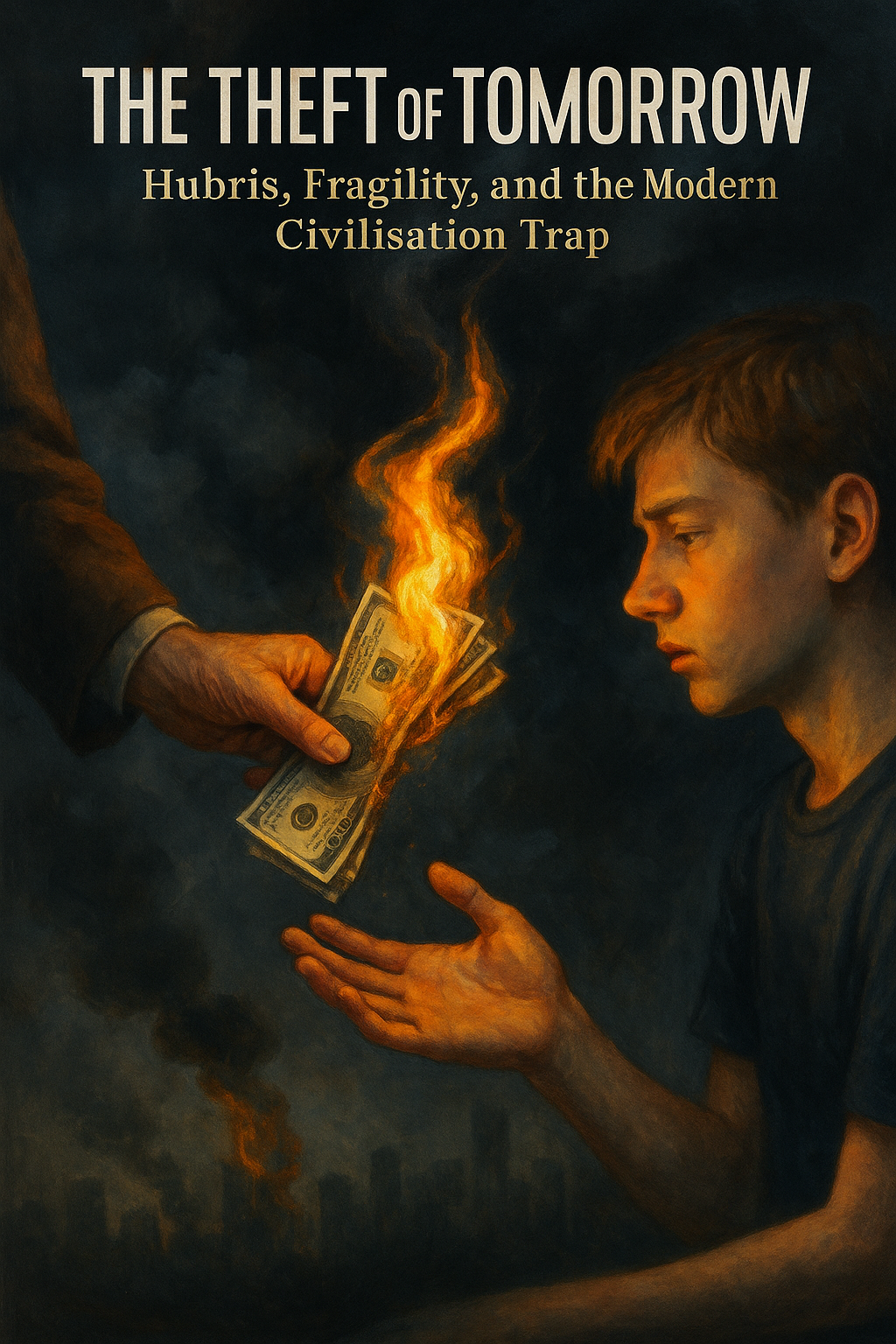
This is not endurance. It is not even indulgence. Paying for comfort with our children’s money is theft. The money, resources, and security of future generations are being consumed now to preserve a fantasy of risk-free life.
The contrast could not be clearer. Billions of people in poorer societies live with scarcity and uncertainty, still investing in education, health, and modest growth without guarantees. The wealthy world raids its own descendants’ inheritance to keep the party going.
Complexity cannot be abolished. Probability cannot be gamed. The stroke of a pen can extend credit, rewrite liabilities, even print money. We can change the rules, extend the terms and even print more money, but paper promises do not feed people, keep the lights on, or cool the planet.
“Boundaries,” “Enough,” “Reality,” “Complexity,” “Probability,” “Limited Liability for Government” — we have the concepts but the actions are unpalatable. Why should our children suffer our self-centredness? Every generation has scolded its youth for softness. But this time the charge belongs to the elders, myself included. It is not the young who are reckless, but the aged — consuming their descendants’ future to protect their own present, built on a wilful disregard of stark realities.