Whose Car is it Anyway?
Tech and the Vanishing Customer
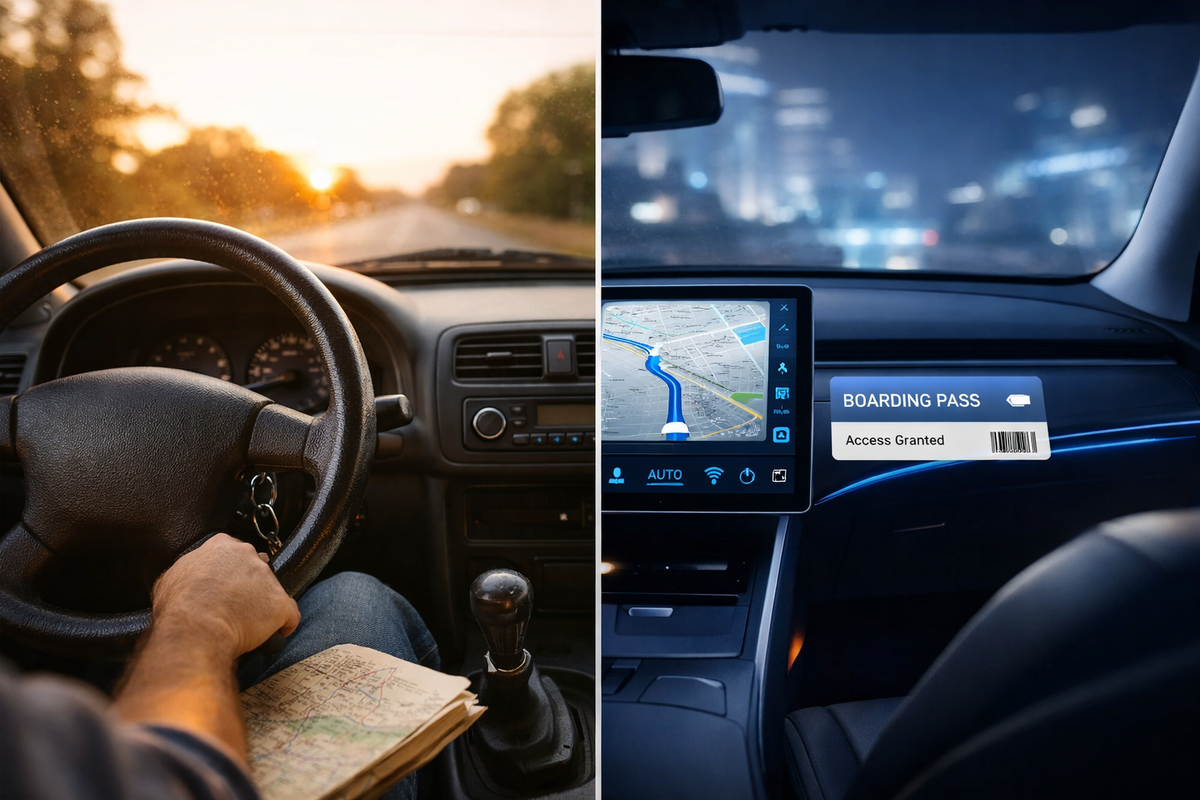
Having recently become a car owner again after more than ten years, I am intrigued to find myself driving what is essentially a mobile computer. It can tell me, with complete confidence, that my shopping on the passenger seat is not wearing a seatbelt, but not when the oil needs topping up.
Of the two, I would prefer the latter. Instead, I am left with the familiar dipstick—still the only reliable way to check something that does not seem so different from how much fuel is left in the tank— all the while surrounded by sensors whose purpose is not always immediately clear.
Then, some things have become unexpectedly difficult and somewhat puzzling. If the battery fails, opening a window from the inside or a door from the outside is no longer easy. Features such as heated seats are already present, but exist in a conditional state, available if an additional payment is made. Overall, I have that feeling that the manufacturer knows more about how the car is used than I do, and maybe its not really mine at all...
The car is more capable than anything that came before it and a sweet drive. However it is not obviously more aligned with me, the person using it. That does not seem accidental. So a simple question follows: when a product becomes this complex, when payment is not transparent, and when ownership is diffusing, what happened to the customer?
Safety First
The car is highly attentive, but selectively so. It prioritises safety signalling (seatbelts, alerts, warnings), regulatory compliance (emissions, mandated systems), and visible “intelligence” (screens, assistance features). It is less attentive to core mechanical state (oil, wear, longevity signals), and to simple, user-friendly feedback on what actually matters for keeping the car running.
The issue is not “too much tech”, but what that tech is pointed at, and who set the priorities.
After Safety Comes Standardisation
It is cheaper to build one system and put it in every car. That reduces manufacturing complexity, but not necessarily the cost to the consumer. When simplicity is for the manufacturer and displaces fit for the buyer, cost saving becomes cost spreading.
Heated seats and high-end audio that are present but not activated in every model illustrate the point. Expensive systems are distributed across all units. Effectively, everyone pays for a standardised, high-end engineering design, whether they use it or not.
More is Less
If complexity dominates, simplicity becomes a casualty. Complex, beautifully designed cars are no longer a consumer choice. They are the baseline, sold fractionally. Bundling groups of features into trims and packages. Presented as enhancement, it makes it difficult to separate cost from value.
Even if this were not the intent, the internal logic dominates. The product is designed around manufacturing, compliance, and margin. The driver is just one input, not the organising principle.
Less is More
Choice still exists, but largely at the surface level—model and trim name. Functional choice has narrowed. There is no longer a truly simple, stripped-down option. It is not possible to exclude unwanted systems to reach a lower price, as they are already built in.
In effect, the entry-level car—something safe, cheap, and fixable—has largely disappeared. What remains is a partially restricted version of a more complex whole. Opting out is no longer part of the offer.
Ownership or Rental?
Complexity drives standardisation, and standardisation brings additional benefits—for the manufacturer. The modern car looks owned, but behaves conditionally. The conditions are set elsewhere.
Features are present in the car when it is bought—heated seats, performance modes—but using them may require additional payment. The customer owns the metal and plastic, but access to function is layered on top.
At the same time, software-controlled systems tie diagnostics and repairs more closely to the manufacturer. This raises costs for independent mechanics and restricts flexibility for the customer. For those living far from a registered dealer, it also introduces practical barriers. The distance between the driver and an affordable solution increases.
Not What You Wanted but What You Got
Ownership of a modern car is a different experience and financial transaction than before. The sector evolves and deploys the best technologies, but the outcome is not obviously aligned with what drivers would have chosen.
What was once a clear purchase of a valuable and durable asset now feels closer to participation in a controlled system. This shift is not absolute, but it is clearly moving in one direction, away from us
..and By The Way
Safety and regulation come with consequences. The environment matters. Materials need to be reused, and overbuilding is wasteful. This is not the starting point, but it is an outcome.
Unused features still consume materials, energy, and cost. In software-led systems, components age faster than the underlying vehicle. Complexity can shorten useful life rather than extend it. Waste is not the intent, but it is a consistent by-product of misalignment.
Its Not Just About Cars
The car industry is not unusual. It is deploying a strategy increasingly visible across B2C:
- Bundling over selection
- Opacity over clarity
- Continuous payment over one-time ownership
- System control over user control
Cars make it visible because they are expensive, physical and so integrated into our lives, so well used that the trade-offs are harder to hide and emerge over months and years
B2C Service Needed
It is too abstract to call for something “better for consumers”. The shifts required are specific:
- Real modularity
Include or exclude features at purchase - Clear pricing
Each feature has a visible cost - Separation of layers
Hardware ownership independent of software access - Guaranteed baseline
Core functionality not dependent on subscription or activation
These are not unique to cars. They apply across the sector.
Whose Car?
The car is not confused. It is doing exactly what it was designed to do. The question is whether that design still centres the person using it, and what the driver actually owns.
The reality is that as a new car driver—owner feels less precise—I have quietly become just one participant in a much larger system