Guyana Equipment Finance Assessment May 2026
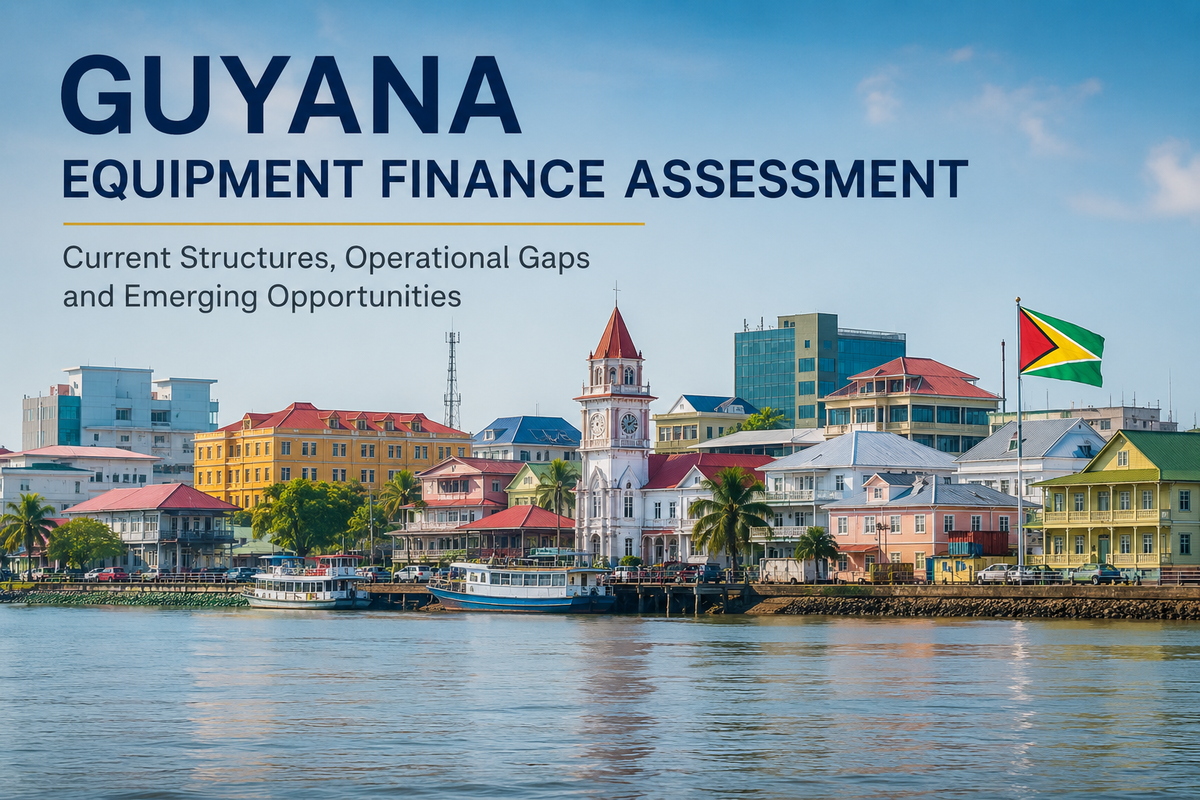
Current Structures, Operational Gaps and Emerging Opportunities
Summary: Guyana’s equipment and SME finance market shows strong underlying demand, reflected in widespread informal private financing and active vendor-led credit in sectors such as construction and transport. However, informal financing cannot scale efficiently, while vendor financing often remains restrictive and brand constrained. Commercial banks rely on collateral and simpler lending approaches despite high market liquidity and persistent demand for productive asset finance. The Government is expanding SME financing through the SME Bureau and the proposed Development Bank, although successful delivery will require a far more specialised operational structure to operate effectively.
There is a clear opportunity to build a platform capable of connecting banks, vendors, government programmes and SMEs more effectively; improving transaction flow and portfolio performance; sharing risk more efficiently; and building the transaction and repayment data needed to scale with the wider economy. Such a platform could rapidly establish strategic market position and long-term enterprise value as the financial sector evolves.
1. Market Context
From an equipment finance perspective Guyana remains a very small market despite its rapid economic expansion, with much of the current oil-related growth still concentrated within relatively narrow sectors and networks. The long-term viability of larger-scale SME and equipment finance will depend on whether current growth broadens into a deeper domestic economy through continued construction activity, immigration, infrastructure development and wider SME participation.
Discussions with banks, legal firms, government entities and market participants nevertheless indicate strong unmet demand for equipment and productive asset finance, particularly in construction, transport, logistics and productive-use sectors. Banking liquidity appears high, while access to US dollar funding for larger equipment purchases remains a recurring operational constraint. Informal and vendor-led financing structures continue filling market gaps outside traditional banking channels, reflecting both strong demand and the limitations of current institutional finance structures.
2. Informal and Vendor Financing
Informal private financing already plays a significant role in productive asset acquisition, including vehicles, transport equipment and smaller commercial assets. This reflects strong market demand and entrepreneurial activity, but remains relationship-driven and does not scale efficiently.
Vendor financing has developed as a practical response to market conditions over many years, particularly among larger equipment distributors. These structures have successfully supported sales growth and asset deployment where traditional bank financing remained limited. However, most remain linked to captive brand sales and internal balance-sheet financing models. As market scale increases, this is likely to create growing pressure around return on capital, portfolio management, collections, residual value management and operational complexity.
3. Commercial Banks
Commercial banks continue to focus primarily on collateral-backed lending, particularly real estate, while remaining cautious around operationally intensive SME and specialised equipment finance structures. Multiple institutions acknowledged both strong demand for productive asset finance and internal pressure to increase SME lending participation.
The Government’s SME Bureau currently operates guarantee structures intended to support SME lending through the banking system, although banks noted that some referrals still do not align well with conventional underwriting requirements and are therefore regularly declined despite the presence of guarantees.
In practice, SME and equipment finance remains more complex and resource-intensive than traditional lending products, particularly in rapidly evolving markets.
4. Government Programmes and the Development Bank
The Government is actively expanding SME financing support through guarantee structures operated by the SME Bureau and through the proposed Development Bank initiative. These programmes reflect a genuine political commitment to increasing SME participation in the wider economy.
Current structures, however, remain heavily dependent on traditional banking processes and approvals. The next phase of SME finance expansion is likely to require more specialised operational capabilities, including sector-focused underwriting, vendor integration, asset monitoring, workflow systems, collections management and portfolio analytics. Without these structures, there is a risk that increased liquidity deployment may not consistently translate into sustainable productive asset growth.
5. Emerging Opportunity
The clearest long-term opportunity may not be the creation of a traditional standalone leasing company, but rather the development of a specialised finance platform capable of improving coordination between banks, vendors, government programmes and SMEs.
Such a structure could:
- improve transaction speed and execution,
- support risk sharing between market participants,
- leverage strong existing private participation in asset financing through more scalable and protected investment structures,
- optimise vendor financing structures,
- improve portfolio monitoring and collections,
- and build the transaction and repayment data needed to scale with the wider economy.
As Guyana’s financial sector evolves, early establishment of this type of operational platform could create significant strategic positioning and long-term enterprise value.
Kevin Kennedy has worked across commercial leasing, SME finance and frontier-market financial sector development with GE Capital, Grenke Leasing, IFC, World Bank / Lighting Global, UNCDF and USAID-supported programmes across Africa and Asia.
✉ kkennedy@sapereaudeconsulting.com ☏ +34 617 841 693