Master of Your Own Studio: Writing in the Age of AI
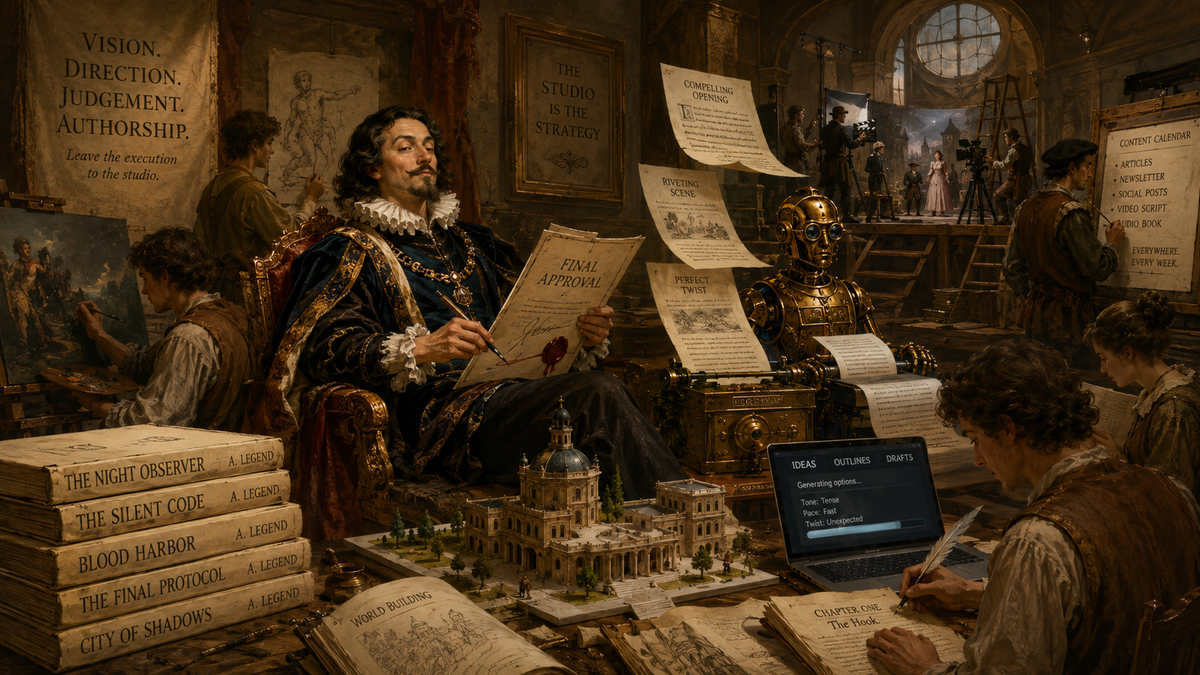
The great masters were apparently not sentimental about doing all the work themselves. As soon as success gave Rubens, Rembrandt and Raphael the money and reputation to stop painting every inch of every canvas, they built workshops and put other people to work. Assistants prepared materials, painted backgrounds, copied established forms and sometimes executed substantial parts of finished works. The master increasingly concentrated on conception, composition, direction, correction and final judgement. Far from diminishing creative status, the workshop became one of the privileges of having achieved it. The greatest painters did not remain solitary craftsmen once another model became available; they became masters of studios.
The same principle is uncontroversial and visible elsewhere. Film directors depend on cinematographers, editors, composers, designers, actors and large production crews. Senior lawyers do not draft every document and famous architects do not worry about where every plug goes. Creative ownership survives because authorship has never required personal execution of every component. It rests on command of the whole.
Writing had its own studio practices long before AI. Editors reshape manuscripts, researchers supply material and ghostwriters write. At the commercial end, the principle can become almost comically explicit. Tom Clancy became not merely an author but a publishing brand, with novels carrying the Clancy name while substantial writing was undertaken by credited collaborators and, after Clancy's death, continuation authors. Whatever discomfort that model may cause, publishing has long since demonstrated that a valuable piece of authorship can extend beyond personally typing every sentence.
So, writing already has studio practices. That is a much more useful starting point than asking whether AI can write and who owns the output. The significant change is that a studio once available mainly to successful authors, large firms and well-funded creative businesses can now sit on a laptop. Research, drafting, editing, criticism, restructuring and repeated experimentation can all be undertaken at negligible marginal cost.
AI successfully loosens the connection between authorship and execution. More effort can move towards choosing the argument, controlling structure and tone, testing alternatives, recognising weak material and deciding what belongs in the finished piece. This does not remove creativity; it changes where much of the creative work takes place. When fluent prose is difficult to produce, fluency itself has value. When fluent prose is cheap, judgement becomes more visible. The ability to select, reject, combine, direct and improve matters more.
There is also a straightforward business consequence. A studio once required salaries. Researchers, editors, analysts and production staff had to be employed before additional intellectual capacity could be bought. AI makes a version of that capacity available to a consultant, writer, entrepreneur or small business at trivial cost compared with building a team.
Perhaps that is the most useful way to approach AI-assisted writing. There is little reason for embarrassment about using the workshop. Painters, architects, directors, lawyers and bestselling authors embraced delegation as soon as status or economics made it possible. The unusual development is that the privilege is no longer reserved for the successful.
The studio is now available so use it. As for mastery? That requirment has not become any easier. It was ever so.
And yes, this was produced with AI.