The Greek Myth vs. Orgnised Religion
And the philosophal winner is .....
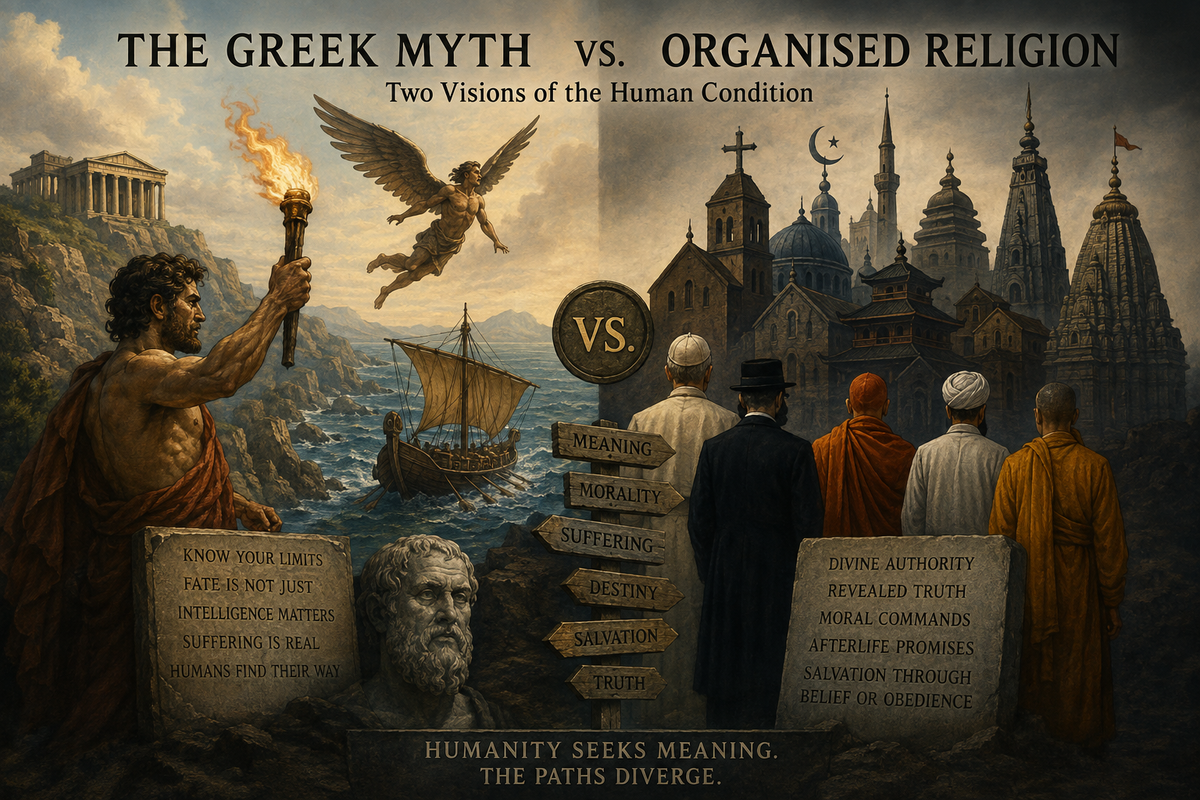
The Greek myths approached the human condition in a strikingly unsentimental way. Their gods were powerful but neither consistently good nor reliably just. Fate did not guarantee reward for virtue. Intelligence mattered enormously, but intelligence did not abolish limitation. Prometheus gave humanity fire and technology; Daedalus engineered escape from physical constraint; Odysseus survived through ingenuity and cooperation. Civilisation expanded the human envelope, but the envelope remained. Mortality, uncertainty, error and consequence survived every advance.
That is what makes the myths philosophically interesting even after belief in the gods has disappeared. The supernatural machinery can be discarded while much of the underlying structure remains intact. Fate becomes probability and constraint. Divine punishment becomes consequence. Hubris becomes systematic overestimation of agency. Promethean fire becomes technology. The universe itself need not be benevolent, morally coherent or arranged for human benefit.
Organised religion can be understood, philosophically, as a retreat from one of the hardest conclusions available to human thought: that reality may possess no intention, no moral structure, no message and no concern for human beings. Greek tragedy came remarkably close to accepting that condition. Suffering could be undeserved, intelligence could fail, power could be arbitrary and no guarantee existed that the universe would explain itself.
Christianity altered that landscape profoundly. Suffering acquired purpose, history acquired direction, morality acquired divine authorship, death acquired continuation, and ultimate justice was transferred beyond observable life. Cosmic indifference became providence; mortality became transition; injustice became temporary; uncertainty became revelation. These moves solved several intolerable problems by changing the premises. The resulting system may be emotionally powerful and socially productive, but explanatory comfort is not evidence.
Many organised religions follow a similar pattern. Human values are projected outward and returned as properties of reality. Moral preferences become divine commands. Historical traditions become revelation. Community rules acquire metaphysical authority. Questions that might otherwise remain open are closed by doctrine. The universe ceases merely to exist and begins to speak, judge, reward, punish and prescribe.
Rationalism reverses that process. No cosmic message is assumed. Values remain human constructions grounded in consciousness, social existence, experience and consequence. Mortality remains mortality. Probability remains indifferent to deservingness. Meaning exists because conscious beings create meaning, not because meaning has been embedded in the fabric of matter.
In that sense, rationalism may be structurally closer to Greek myth than organised religion is. The Greeks personified the forces that bounded human life; rationalism depersonalises them. Fate becomes probability, necessity and physical law. The gods disappear, but the central insight survives: finite beings operate inside a reality that does not communicate, does not care and does not negotiate.
On this account, organised religion can represent a philosophical step backwards even while representing a social advance in particular historical settings. Religion has created institutions, art, solidarity, moral vocabularies, education and political restraint; religion has also produced hierarchy, exclusion and coercion. Those questions belong largely to history and sociology. The philosophical issue is narrower: whether explanation improves when human hopes are attributed to the universe.
Rationalism offers less consolation at the level of doctrine, but perhaps greater intellectual economy. Reality requires no intention behind reality. Values require no cosmic legislator. Death requires no continuation. Technology and cooperation can expand the human envelope enormously, but they do not remove its existence. The universe simply is; the human challenge begins from there.